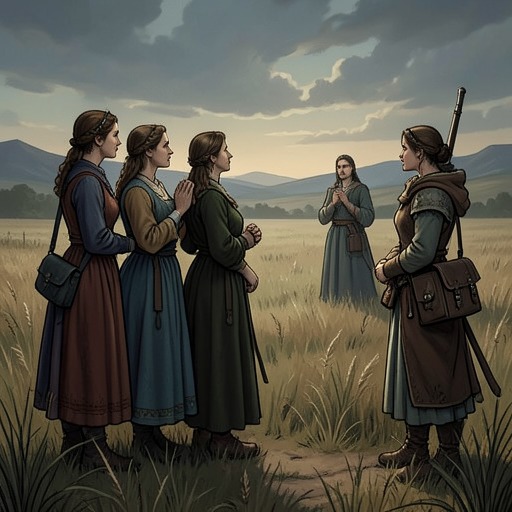
Angel carries the milkmaids across the flooded lane
Tess of the d'UrbervillesAngel carries the milkmaids across the flooded lane in an episode that turns an ordinary Sunday outing into a public disclosure of feeling. The water is a real obstacle, but the crossing also brings Angel and Tess into sudden physical intimacy; afterward, Marian and the others recognize that he favors Tess, and Tess can no longer deny the force of her attachment to him.
The flooded road
The episode begins on a Sunday morning, two months after Tess Durbeyfield arrived at Talbothays Dairy. The milking is finished, the outdoor milkers have gone home, and Tess is setting out with the other three young women for Mellstock Church, three or four miles from the dairy-house. It is her first excursion from the dairy. The previous afternoon and night brought heavy thunderstorms that washed some hay into the river; the morning has cleared brightly, but the rain has left a stretch of the crooked lane under water.
At the lowest point, the flood covers the road over-shoe for about fifty yards. On a working day the women could have walked through in their boots without much concern. This is different: they are wearing white stockings, thin shoes, and pink, white, and lilac gowns, and the mud would show on their clothes. The church bell can already be heard, still nearly a mile away. Marian and Retty see no easy solution: walking through the water would ruin their Sunday finery, while taking the Turnpike way would make them late.
The lane’s physical conditions set the action in motion. The girls climb onto the roadside bank and try to keep their footing along its slope, waiting and worrying as the church bell calls. Angel Clare appears around the bend, walking through the water in dairy clothes and long wading boots, a cabbage leaf inside his hat and a thistle-spud completing his ungainly outfit. His practical workday appearance is an abrupt contrast with the women’s carefully chosen church clothes.
A rescue becomes an encounter
Angel asks whether the women are trying to reach church, then offers to carry every one of them across. He tells them to stand still, insists that none is too heavy, and shows each how to put her arms around his shoulders. The crossing proceeds one at a time. Marian lowers herself onto his arm and shoulder; Angel carries her through the water and returns for Izz Huett, who has been watching the approach with visible emotion. The routine kindness of the task does not prevent the embraces from feeling charged to the women.
When Angel returns for the third time, he carries Retty Priddle. As he takes her up, he glances at Tess; his expression seems to communicate that Tess will be next. Retty proves the most difficult burden, not because she is heavy but because she is overcome with nervous excitement. Angel gets her to dry ground, leaves the first three women together there, and comes back for Tess.
Tess tries to avoid being carried. She says she might be able to climb along the bank and points out that Angel must be tired. He quickly refuses the suggestion, and before she is fully aware of what is happening she is seated in his arms, resting against his shoulder. Her hesitation marks the difference between the practical rescue Angel is performing and the emotional significance the contact has acquired for her.
Angel whispers, “Three Leahs to get one Rachel,” alluding to the biblical sequence of wives. Tess answers that the others are better women than she is, holding to her resolve not to draw him away from them. Angel replies, “Not to me.” The exchange makes his preference plain without turning the moment into a formal declaration. He exclaims, “O Tessy!” as they stand still, but her burning cheeks and inability to meet his eyes remind him that he is taking advantage of an accidental closeness. He goes no further: no definite words of love have passed between them.
The crossing’s aftermath
Angel walks slowly, lengthening the remaining distance before the road bends and the other women can see them again. Once they reach dry land, he sets Tess down, hastily bids the group farewell, and splashes back through the flooded stretch. The physical crossing is over, but its meaning has become visible to the women who watched. Marian tells Tess that Angel likes her best and says they could see that he would have kissed her if she had encouraged him even slightly.
The three milkmaids do not answer this recognition with hostility. Their gaiety has vanished, and Marian looks joylessly at Tess, but the women do not blame her. They have all fallen in love with Angel, yet they regard Tess’s apparent precedence as something destined to happen rather than an act of deliberate betrayal. Their generous response makes the episode a scene of shared disappointment as well as romantic revelation.
Tess’s divided response
For Tess, the crossing exposes a conflict already gathering beneath her attempts to keep Angel’s attention from herself. Her heart aches as she admits inwardly that she loves him; knowing that the other women have also lost their hearts to him intensifies rather than diminishes her feeling. The narrator describes the sentiment as contagious, passing among the women, while Tess’s own hungry nature has struggled against it without success.
That night Tess tells Retty through tears that she will never stand in the way of her or either of the others. She insists that she cannot help her feelings, but says she does not think Angel intends to marry and that, even if he were to ask, she would refuse him as she would refuse any man. The promise preserves Tess’s declared loyalty to her companions while exposing her emotional uncertainty: she has already been carried into a closeness she did not seek, and the others have seen what she is trying not to acknowledge.
Narrative significance
The lane is more than a backdrop for a romantic encounter. The storm has temporarily made the ordinary route impassable, and the women’s Sunday clothes prevent them from simply treating the water as another stretch of working ground. Angel’s practical solution therefore requires touch: each woman must put her arms around his shoulders and trust him to carry her. The same act that solves the immediate problem creates a visible comparison among the four crossings, culminating in the charged pause with Tess.
The scene also moves feeling from private sensation into shared knowledge. Angel’s glance, Tess’s blush and avoidance, and the women’s watching do more than a spoken declaration could at this stage: they establish his preference and make Tess’s attachment legible to the group. The rescue ends with no kiss and no promise, but with a changed understanding between Tess and the other milkmaids. Its central reversal is quiet yet consequential: Tess tries to redirect Angel toward the others, while the journey across the water confirms to all of them that his attention has settled on her.